
ENERGY RISK & PORTFOLIO MANAGEMENT
Solving the
Time-to-Power Gap for Hyperscale Data Centers
9+
Unique generation and storage technologies evaluated
100+
Structured proposals assessed
2
Novel nuclear SMR PPAs executed
Industry
Technology
Country
USA
Focus
Energy Risk & Portfolio Management
Client Type
Fortune 50 Technology Company
When data center growth outpaces energy infrastructure
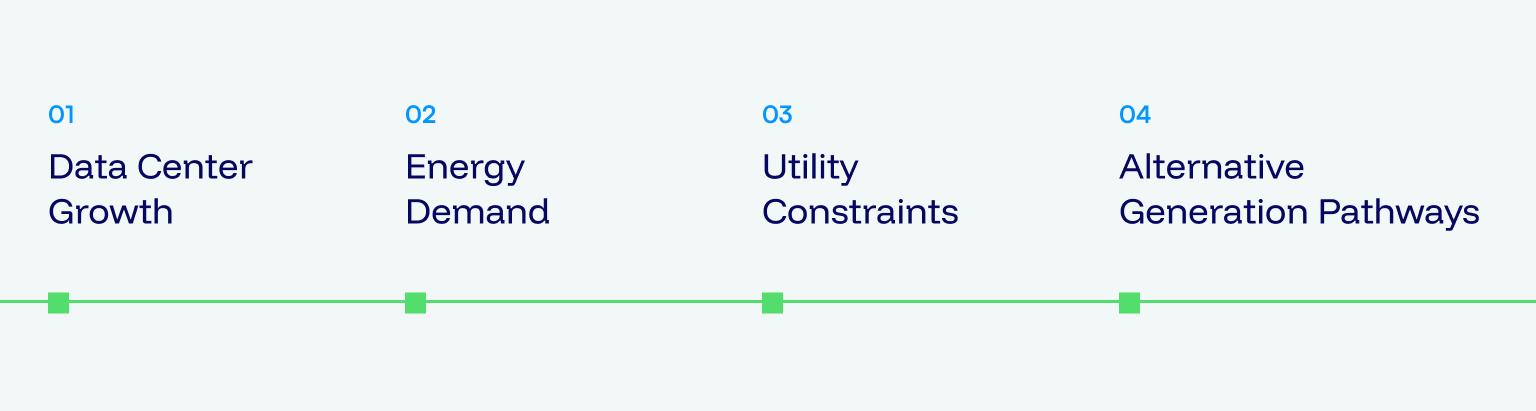
The rapid expansion of hyperscale data centers is reshaping electricity demand globally.
Large-load facilities increasingly require power capacity at a pace that utilities often struggle to match. As infrastructure development timelines expand, organizations face growing pressure to identify scalable pathways capable of supporting near-term load growth.
For rapidly expanding technology companies, energy availability itself can become a strategic constraint.
The challenge
A leading Fortune 50 technology company operating in full-growth mode faced a widening time-to-power gap as new hyperscale data centers came online.
The speed required to energize 500+ MW hyperscale facilities significantly outpaced the ability of host utilities to provide reliable supply.
The company needed modular, scalable, and self-owned generation solutions capable of supporting aggressive growth timelines.
What initially appeared to be a technology evaluation challenge quickly became a broader infrastructure and procurement question.

Key considerations:

500+ MW power requirements
Accelerating hyperscale growth
Utility supply limitations
Modular generation pathways
Scalable infrastructure planning
Near-term deployment needs
Polar's approach
Polar expanded the engagement beyond a traditional desktop techno-economic assessment.
Rather than limiting the process to theoretical technology comparisons, Polar designed a structured RFI process capable of engaging developers and operators across modular and semi-permanent generation technologies.
Operating as a market intermediary allowed Polar to move beyond assumptions and collect commercial, technical, and deployment realities directly from participants.
From technology evaluation to market engagement
The structured RFI process was designed to address real-world hyperscale data center use cases.
The process engaged providers across multiple technology categories, including:
- Nuclear SMRs
- Linear generators
- Fuel cells
- Energy storage
- Aeroderivative turbines
- Stationary engines
The initiative ultimately generated more than 100 proposals representing commercial terms, deployment assumptions, and implementation pathways.

Five-stage evaluation process
Opportunity Framing
Define load requirements, deployment timelines, and growth assumptions.
01.
Market Outreach
Engage technology providers and generation developers.
02.
Proposal Collection
Gather commercial structures and deployment pathways.
03.
Technical and Commercial Review
Assess scalability, feasibility, and implementation requirements.
04.
Strategic Execution
Identify pathways capable of supporting long-term infrastructure needs.
05.
Key elements of the solution:
Structured RFI process built around real hyperscale use cases
Evaluation across multiple modular generation technologies
Commercial and technical assessment frameworks
Direct engagement with technology developers
Real-world proposal analysis beyond theoretical assumptions
Strategic pathways capable of supporting rapid deployment needs
Results
9+
Generation and storage technologies evaluated
Expanded visibility across emerging infrastructure pathways.
100+
Proposals
assessed
Created market visibility across technical and commercial alternatives.
2
Novel nuclear SMR
PPAs executed
Moved the engagement beyond evaluation and into implementation.
The original engagement began as a research initiative but evolved into commercial execution and long-term infrastructure planning.
Outcomes achieved:
Expanded generation pathway visibility
Accelerated infrastructure decision-making
Created market intelligence beyond theoretical modeling
Identified scalable alternatives for constrained utility environments
Enabled commercial execution through novel procurement structures
Established long-term approaches to support future data center growth
Balancing growth and energy availability
For rapidly growing organizations, energy procurement increasingly extends beyond traditional utility relationships.
Infrastructure strategy, deployment timing, and generation flexibility now play a larger role in enabling growth.
Key takeaway:
The challenge was never simply identifying new technologies.
The larger challenge involved transforming emerging generation options into practical pathways capable of supporting real-world infrastructure growth.
When energy availability becomes a business constraint, evaluation alone is not enough. Execution strategy becomes equally important.
Planning infrastructure around emerging energy constraints?
Connect with our team to explore approaches designed for large-scale energy planning, procurement, and infrastructure strategy.